
What California VINE Covers
California VINE is available at vinelink.vineapps.com/state/CA. The service is described as a free and confidential way to access custody status and criminal-case information and find state-approved service providers. The national VINELink site and mobile app provide the broader entry point if the state URL changes or the user starts outside California.
Coverage depends on agency participation and data feeds. For an Amador County Jail question, VINE is a status and alert channel that should be paired with the Amador Sheriff Citizen RIMS portal and the Sheriff's Records Division. For a state-prison question involving Mule Creek State Prison, Pine Grove Youth Conservation Camp, or another CDCR facility, VINE may supplement CDCR/CIRIS and CDCR records. For federal or immigration custody, use BOP or ICE channels because VINE is not the owner of those records.
The manifest includes a capture from the California VINE state entry page.
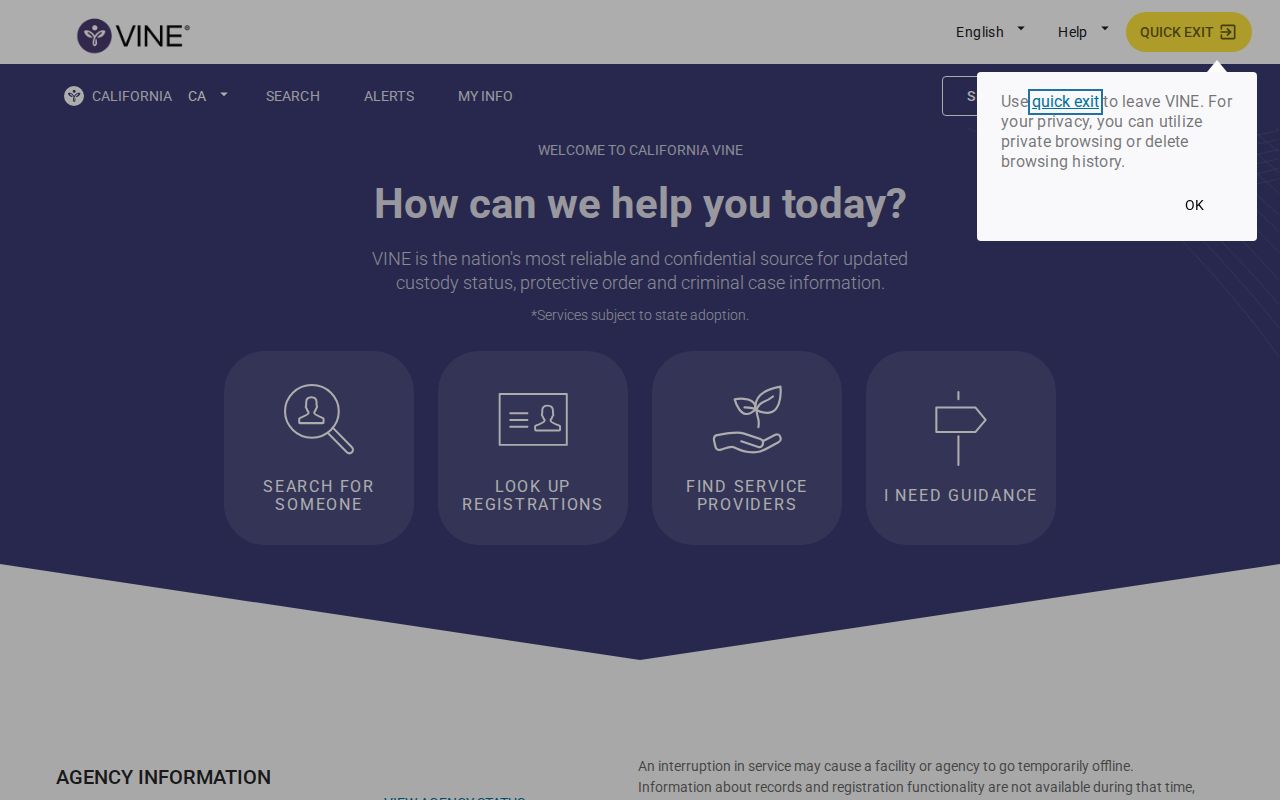
Use the state entry page to begin the search, then confirm any official document through the agency that owns the jail, prison, court, or custody record.
Check One Amador Person
A VINE check is person-specific. It is not the same as browsing Amador County's recent releases, and it will not create a historical release packet.
- Open California VINE or start from VINELink and choose California.
- Choose the offender or person search option available in the interface.
- Search by last name and first name, or by a specific identifying number if one is available.
- Compare the agency, facility, age or date-of-birth information if shown, case details, and custody details before relying on a match.
- If the person is shown in custody, review custody status and available notification options.
- If the person is shown released, note the displayed release/status text, then confirm with the sheriff, CDCR, court, BOP, or ICE source that owns the record.
- If no result appears, do not conclude that no custody or release occurred. Check whether the person was in Amador County Jail, CDCR, federal custody, immigration custody, another county, or a court-only status.
For Amador County Jail releases, VINE should be part of the evidence stack with the sheriff release document and Amador Superior Court docket. The sheriff Records Division stores original booking and release documents; the court portal can explain the case event that caused the release.
If the person was recently visible in RIMS and then disappeared, VINE may help identify whether the custody feed recorded a change. It still cannot explain every outcome. A person may have been released on bail, transferred to CDCR, moved to another county, held on a federal matter, released to immigration custody, or removed from public display for reasons unrelated to release. Use VINE as a signal, then follow the signal to the correct record owner.
What VINE Shows About Release
VINE may show custody status and release or custody-change information depending on the agency feed. It normally does not provide a full release packet, sentence calculation, booking photo, or long-term archive.
| VINE item | How to read it |
|---|---|
| Custody status | Shows whether the person is reported in custody, released, transferred, or otherwise changed by the participating feed. |
| Agency or facility | Helps separate Amador County Jail from CDCR, another county, or another participating agency. |
| Identifying details | Use only enough detail to confirm the correct person and avoid confusing same-name records. |
| Notification options | May allow phone, email, text, app, or TTY alerts where available. |
| Released result | A useful status clue, but official proof still comes from the sheriff, CDCR, court, BOP, or ICE record owner. |
If the person has aged out of the VINE feed or was never covered by a participating source, the sheriff Records request, CDCR Identification Unit, CDCR Public Records Portal, court copy request, BOP locator, or ICE ODLS may be the better route.
VINE also should not be used to infer booking-photo access. Amador's public RIMS configuration disables inmate and arrest photos, and VINE is not the sheriff's booking-photo records office. If identification depends on a photo, use the booking information carefully and request any releasable booking photo through the sheriff Records Division rather than expecting VINE to supply it.
Register Before Release
The distinctive Amador value of VINE is that it fills part of the notification gap left by the absence of a verified 24-hour or 72-hour sheriff release feed. Register while the person is still searchable. After release, VINE may be less useful as an archive.
- Select the matched person in California VINE.
- Choose a notification type: app, phone, email, text where available, or TTY.
- Enter the contact number or email address requested by the system.
- Create or enter the confirmation PIN required for phone notification. California county VINE explanations commonly identify a four-digit PIN.
- Confirm the registration and keep the PIN available.
- When a phone alert arrives, enter the PIN to acknowledge it. Some VINE phone systems continue calls until the PIN is entered.
- Update or cancel the registration when the alert is no longer needed.
The VINELink app page says the portal operates 24/7/365 and supports custody-change notifications by in-app notification, phone, email, text where available, or TTY. That makes it useful for a possible overnight or weekend release, but it should not be treated as the only source.
For Amador County, registration timing is the key Section 19 angle. There is no verified sheriff 24-hour or 72-hour release feed to watch, so the person who needs an alert should register before the release occurs. Waiting until after the person leaves custody can turn VINE into a weaker historical check, because coverage and retention depend on the participating feed.
Limits and Official Proof
Confirmation rule: VINE is an alert and status layer. It is not the official release document for Amador County Jail, a CDCR discharge record, a court minute order, a BOP release record, or an ICE custody record.
For a local Amador jail release, the official proof path is the Amador County Sheriff's Office Records Division and the court docket. The sheriff page says original booking and release documents from the Amador County Sheriff's Detention Facility are stored by Records. Court records may show bail, dismissal, sentence, probation, commitment, transfer, or another event that explains why custody changed.
For state prison, use CDCR CIRIS, CDCR Identification Unit assistance at (916) 445-6713 during the published weekday hours, CDCR's Public Records Portal for formal requests, BPH results when suitability proceedings are involved, and DAPO for parole supervision. For federal release, BOP's locator is the direct status source. For immigration custody, ICE ODLS is designed for people currently in ICE custody or in CBP custody more than 48 hours.
The Amador facility mix makes the source distinction practical. A person released from Mule Creek State Prison is a CDCR release even though the prison is in Amador County. A Pine Grove Youth Conservation Camp record may involve CDCR, the sending county, court authority, or confidentiality limits. A person released from Amador County Jail is a local sheriff release first, even if CDCR, federal, or immigration custody follows.
Amador VINE Workflow
For a likely county jail case, search RIMS first to collect the exact name spelling, booking date, and booking number if available. Then search California VINE for a matching person and agency. If VINE shows a custody change, save the status wording for your notes and request the official release document from Sheriff Records. If VINE shows no match, do not stop; move to the court portal and Records request because VINE coverage can miss or age out records.
For a likely CDCR case, start with CIRIS because CDCR number and current location are more reliable than a name-only VINE match. If CIRIS shows Mule Creek, Pine Grove, or another CDCR location, use VINE for notifications and CDCR for the formal custody or release record. If BPH dates or outcomes appear, check the BPH schedule or results page to understand the parole-hearing context.
For a release that may have gone to another system, use the transfer clue. BOP handles federal post-sentence status, ICE ODLS handles current ICE custody, and USMS does not publish a public prisoner-photo or release roster. VINE is useful only when its participating data feed covers the custody event you are checking.
VINE and Registries Differ
VINE should not be confused with the California Megan's Law registry. Megan's Law is a public-safety registry for covered sex offenders and is governed by Penal Code section 290.46, including strict use limits. It may provide release-year information for certain registrants, but it is not a general released-inmate lookup, not a jail release list, and not a substitute for the sheriff or court record.
No Amador-specific local registry equivalent to Megan's Law was verified in the sources reviewed. State parole wanted-offender resources may exist through CDCR DAPO, but those are state parole channels, not a county jail release archive.
Use the same matching discipline inside VINE. If multiple people share a name, compare facility, agency, age or date-of-birth details if displayed, and case context before registering for alerts. A wrong match can create confusing notifications and may lead a user away from the sheriff, court, or CDCR record that actually controls the Amador case.
Save the date and time of any VINE result with your notes. If a later sheriff, court, or CDCR record differs, the agency record controls the official correction path.