
Projected Date vs Actual Release
A projected, scheduled, tentative, parole-eligible, or minimum-eligible date is not the same as the actual release. A pretrial Amador County Jail detainee may have no fixed release date because release can depend on bail, a court order, dismissal, transfer, holds, or jail processing. A sentenced county-jail person may have a release calculation tied to court credits and jail records. A state-prison person may have CDCR credit rules, parole eligibility, BPH action, or discharge processing.
Amador rule: county jail release date equals sheriff Records plus court docket; state prison release date equals CDCR/CIRIS, CDCR Identification Unit, BPH/DAPO where relevant, and the sentencing court; federal release date equals BOP; immigration custody equals ICE ODLS.
For a person who was physically in Amador County because of Mule Creek State Prison or Pine Grove Youth Conservation Camp, do not request the Amador County Jail release record unless the person was separately booked at the county jail. CDCR is the state record owner.
For someone who was arrested locally and booked into the Amador County Jail, the release date may be a completed event rather than a future projection. The sheriff release document can identify the time and manner of release, while the court docket explains why it happened. That is different from a state prison release calculation, where the date may be tied to credit rules, parole eligibility, BPH review, or CDCR discharge processing.
Find the Correct Date Source
Begin by identifying the custody lane before searching for a date.
- For Amador County Jail, check Amador Sheriff Citizen RIMS for current custody and recent booking context.
- If the person left the jail, request the original booking/release document from Amador Sheriff Records.
- Search Amador Superior Court's public portal for case events, minute orders, charges, dispositions, sentencing, probation, or transfer orders.
- For CDCR custody, search CIRIS by CDCR number if known, or by name with spelling variants.
- If CIRIS is unclear or no release-related date appears, call CDCR Identification Unit at (916) 445-6713 during the published weekday hours or use CDCR's Public Records Portal.
- For parole-suitability cases, check BPH hearing schedules and results, then DAPO if parole supervision follows release.
- Use VINE Inmate Check for custody-change alerts, but confirm official documents with the record owner.
The manifest includes a screenshot from CDCR CIRIS, the state search route for California incarcerated records.
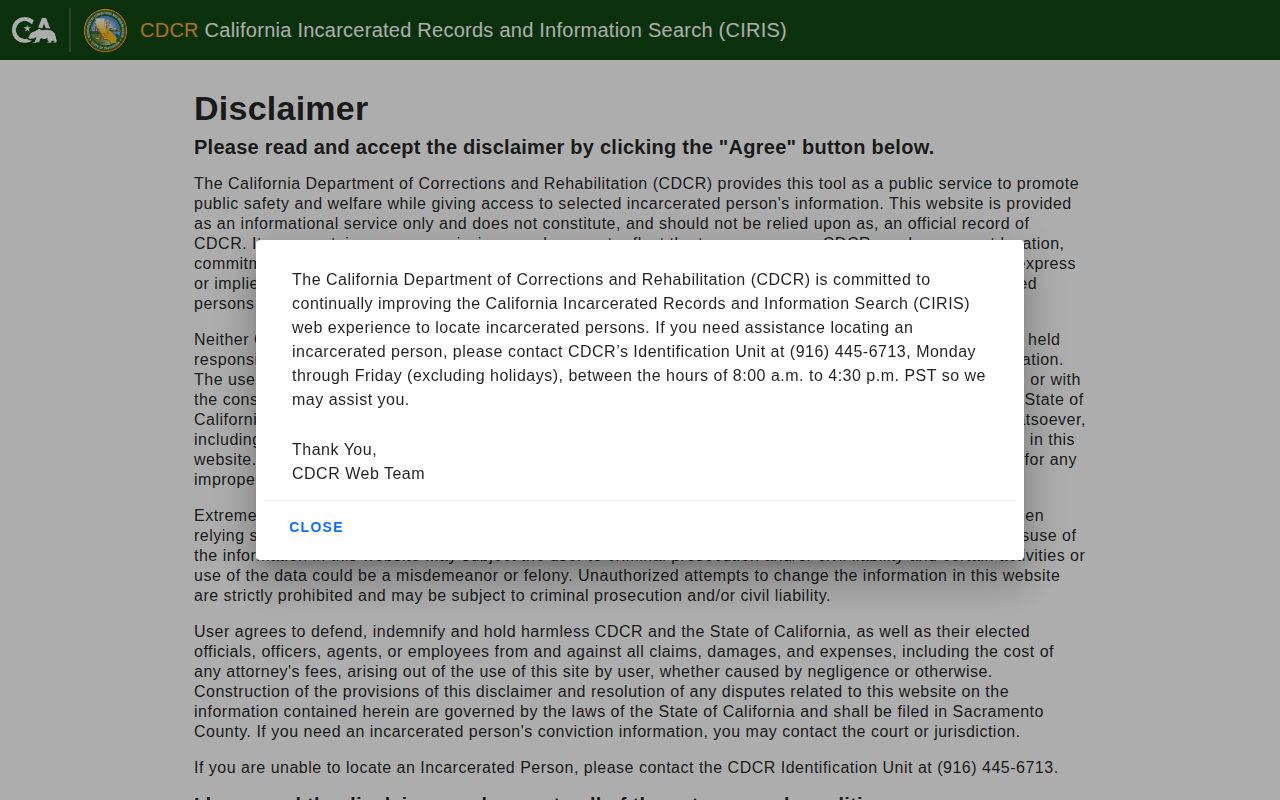
CIRIS is the right state starting point, but it is not a county jail release archive and should not be described as showing every projected release date.
When CIRIS does show a current location, compare it with the question being asked. If the record shows Mule Creek State Prison, Pine Grove, or another CDCR facility, the person is still in state custody unless another official source shows a later change. If the record is missing, that does not automatically mean release; it may mean the person was never in CDCR, the name search failed, the public display is limited, or another record channel is required.
CIRIS Fields and Limits
CDCR's public population search is California Incarcerated Records and Information Search, or CIRIS. CA.gov descriptions say CIRIS results include name, CDCR number, age, current location, commitment counties, admission date, and Board of Parole Hearing dates/outcomes for incarcerated persons currently in CDCR custody. That description supports custody-status and parole-hearing checks, but it does not support promising a public projected release date field for every person.
If a projected, release, parole-eligible, or similar date is displayed, treat it as a public status clue and verify before acting on it. If no date is shown, use CDCR Identification Unit assistance or a CDCR records request. The public status can change after credit recalculation, court orders, disciplinary credit loss or restoration, resentencing, detainers, transfers, BPH decisions, governor review where applicable, or data-update lag.
Commitment county is another Amador-specific issue. A person housed at Mule Creek State Prison in Ione may have been committed from another county. Conversely, an Amador-sentenced person may be housed outside Amador County. The release-date source is still CDCR and the sentencing court, not the county where the prison building sits.
CDCR's Identification Unit is the research-supported help route when CIRIS is unclear. The CDCR contact page lists assistance at (916) 445-6713, Monday through Friday excluding holidays, 8:00 a.m. to 4:30 p.m. Pacific Time. For formal release or discharge records, CDCR's Public Records Portal is the structured request channel, while requests may also be submitted by other methods and manually entered into the portal according to the research.
California Credit Rules
California release-date calculations are case-specific. Penal Code section 2933 is the general worktime-credit framework for many determinate sentences. Penal Code section 2933.1 limits credits for violent felonies listed in section 667.5(c) to no more than 15 percent, which is the basis for the common "about 85 percent" shorthand. Penal Code section 2933.2 eliminates conduct credits for murder. County jail credits often involve Penal Code section 4019 and related exclusions.
Those statutes do not let a public website calculate a reliable release date from a sentence length alone. The actual date may depend on the exact conviction, sentence, credits awarded by the court, CDCR credit category, disciplinary history, program credits, court amendments, and holds. For a county jail sentence, the sheriff and court record should be checked. For a CDCR sentence, CDCR and the sentencing court should be checked.
For life-sentence cases, the better phrase is often "minimum eligible parole date," not "projected release date." BPH materials say life prisoners become eligible for parole hearings by statute one year before the minimum eligible parole date. A parole hearing is a suitability proceeding and does not automatically equal release.
Why Release Dates Move
| Factor | Effect on date |
|---|---|
| Court resentencing or amended abstract | May change the controlling sentence, credits, or commitment terms. |
| Conduct credit loss or restoration | Can move a state or local release calculation forward or backward. |
| New holds, warrants, or detainers | May prevent physical release even when one custody term ends. |
| BPH action | A grant, denial, postponement, waiver, or review can affect parole timing. |
| Transfer to another system | County release may be followed by CDCR, another county, federal, or immigration custody. |
The BOP locator explicitly warns that federal release dates may change due to sentence recalculation. For California CDCR, the same caution should be framed through state credit statutes, CDCR contact limits, court changes, and parole-board action rather than assuming a single fixed public field.
County jail dates can move for simpler but still important reasons. A person may be held on another agency's warrant, released after a late court order, delayed by processing, or transferred instead of released to the community. If RIMS no longer shows the person, the release document should identify whether custody ended locally or shifted to another authority.
Parole Eligibility Is Different
BPH conducts parole-suitability proceedings and nonviolent offender parole reviews for people under CDCR jurisdiction. Its hearing schedules identify date, time, location, and whether hearings are in person or by video, and the research notes those schedules are updated weekly on Thursday morning. Its results page posts recent proceedings by week and month.
A proposed BPH grant is not always the final physical release date. BPH materials say hearing-panel decisions are proposed and generally become final within 120 days unless review changes the result. For someone housed at Mule Creek, a BPH entry may explain parole status; for an Amador County Jail detainee released on bail or probation, BPH usually will not be involved unless there is also a state-prison case.
Minimum eligible parole date is also not a promise of release. It is the point at which a person may be considered under the applicable parole framework. The outcome can still be denial, postponement, waiver, stipulation, grant subject to review, or another action. Use BPH results to explain parole-hearing history, then use CDCR and DAPO channels for custody and supervision follow-up.
Confirm the Date
For Amador County Jail, confirm with the sheriff release document and Amador Superior Court. For CDCR, confirm with CIRIS, CDCR Identification Unit, CDCR records, BPH, and DAPO when parole follows. For federal releases, BOP says a past listed date with no facility shown means the person is no longer in BOP custody, though another system may still be involved. For immigration custody, ICE ODLS is a current-custody locator, not a county jail release certificate.
Use California VINE before the release when alerts are needed. After release, VINE may still show a status clue, but the official proof layer remains the sheriff, court, CDCR, BOP, or ICE source tied to the custody event.
For Amador County Jail, include enough detail in a Records request to avoid a name-only search problem: full name, date of birth if known, approximate booking date, booking number from RIMS if available, arresting agency, and the specific release-date or release-manner item sought. For court records, ask for the docket, minute order, sentencing order, probation order, dismissal, or commitment order that explains the custody event.
For state prison, include the CDCR number if known, full name, date of birth, facility, approximate release or discharge date, and commitment county. For a person housed at Pine Grove, remember that youth-related records may be limited and the sending county or court authority may be part of the record path.
For a local Amador jail date, do not substitute a current roster screenshot for the release document. RIMS can help identify the booking, but the sheriff's original release document and the court file are the sources that explain the final release event.
For a CDCR date, keep the parole and discharge questions separate. A person can have a BPH hearing history, a parole-eligible date, a current prison location, and a later DAPO supervision record, but those are not the same field. If a family member or attorney needs an exact release or discharge document, CDCR records channels are more reliable than trying to calculate the date from public search results.
For a federal or immigration-related Amador case, the county records may only show the local handoff. BOP or ICE information is needed to determine what happened after that handoff.