
Amador Has No Verified 72-Hour Feed
A 72-hour release list normally catches people who left a jail over the last three days, including weekend or holiday releases that may be missed in a same-day check. For Amador County, the sources reviewed did not show a sheriff page titled "72-hour releases," "released last 72 hours," or a comparable rolling release roster. The public RIMS portal should not be described as that kind of archive.
The RIMS inmate route remains useful because it can show whether someone is currently in custody or was recently booked. Its public configuration includes booking and arrest fields, a released indicator, status, charges, bail data, and demographic fields, but it does not publish an official 72-hour release window or retention schedule. The sheriff Records Division is the durable source because it stores original booking and release documents from the Amador County Sheriff's Detention Facility.
Three-day caution: if a person was on RIMS earlier this week and is gone now, that may mean release, transfer, data aging, restricted access, or a name mismatch. Confirm the outcome before relying on the absence.
Check This Week's Jail Status
Use the wider 72-hour window as a checklist across systems. It is especially useful when a booking appeared on Friday, over a weekend, or near a holiday and the live roster no longer answers the question.
- Search Amador Sheriff Citizen RIMS incarcerated people for the current listing or recent booking clue.
- Record the booking ID, date/time, arresting agency, arrest location, charges, status, bail, and any release/status indicator if displayed.
- Check the RIMS arrests route only as arrest context; the research found an arrests age-out setting, not a release-feed retention window.
- Request the booking/release document through Amador Sheriff Records when the person is no longer shown or the status is ambiguous.
- Search Amador Superior Court case search or the public portal for court events, charges, dispositions, minute orders, and future appearances.
- Check California VINE for custody-change notification or a displayed release/status result, if the person is still retained by the notification system.
- When court records show state prison involvement, move to CDCR/CIRIS, the CDCR Identification Unit, BPH results, and DAPO/parole contacts.
The 72-hour process is not a substitute for the 24-Hour Releases same-day page. It is a broader sweep for people who were recently in the local jail but may no longer appear in live custody data.
What RIMS Can Show
Because Amador does not publish a verified 72-hour release list, the field table below describes the RIMS clues that support a records request rather than fields from a dedicated release feed.
| RIMS clue | Why it matters for a 72-hour check |
|---|---|
| Current custody or recent booking presence | Shows whether the person is still visible in the jail-oriented public view. |
| Booking ID and booking-complete flag | Helps the sheriff locate the correct booking/release document. |
| Status and released boolean | May indicate a custody change, but should be treated as a prompt for official confirmation. |
| Charges, holds, bail, and arresting agency | Connects the custody event to the right court case, bail issue, or transfer path. |
| Inmate or arrest photo | Not available through the public RIMS configuration reviewed; inmate and arrest photos are disabled. |
The capture in the manifest from the Amador Sheriff Citizen RIMS portal shows the public portal context for these checks.
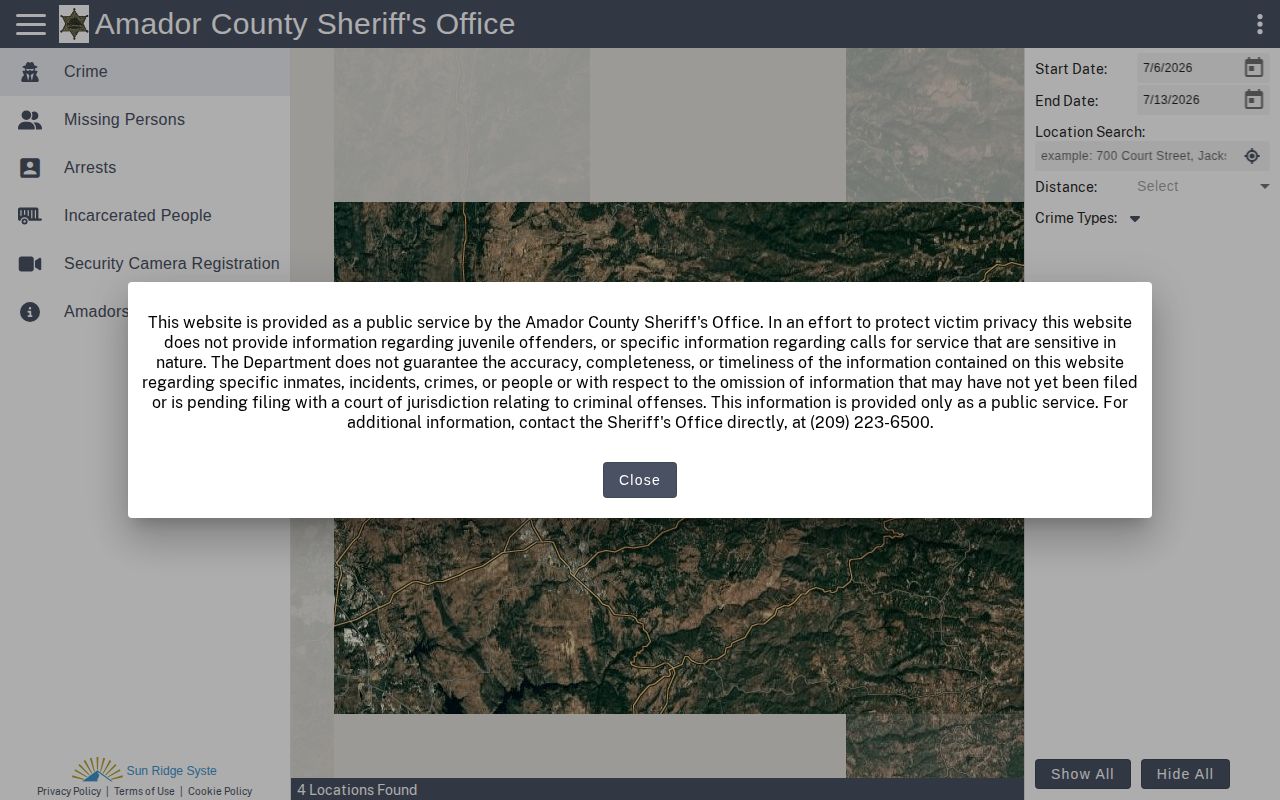
Use RIMS to gather identifiers and custody clues, then use the sheriff and court channels for the actual release answer.
Weekend and Holiday Releases
A three-day window matters because a person may leave the Amador County Jail after regular business hours, over a weekend, or around a court holiday. The jail's operational page and sheriff homepage identify the Jackson facility and sheriff contacts, but the researched sources did not publish a precise release-list update cadence for RIMS. Treat the portal as live/current public information, not as a guaranteed after-hours release log.
For a weekend disappearance from the roster, start with the last known booking date and the court case. Court action may explain release on bail, own-recognizance release, dismissal, sentence credit, probation, transfer to CDCR, or another authority. Amador Superior Court online information starts with cases from 2002 and can include docket events, charges and dispositions, minute orders, and events where public access allows.
If the issue is transportation or pickup, confirm directly with jail staff. Amador's rural transit and dispatch patterns make it risky to infer pickup logistics from a roster change alone.
Weekends can also blur the difference between "released from jail" and "case resolved." A person may leave custody after bail, a judge's order, or completion of a short local sentence while the docket still has future events. The three-day check should therefore include both the sheriff record and the court record. If the court file shows a CDCR commitment, stop treating the case as a local jail release and use state prison channels.
Sheriff Records Is the Archive
The Amador Sheriff's Records Division page is the key fallback for this page. It says Records maintains reports, incidents, citations, jail booking records, and original booking and release documents from the Amador County Sheriff's Detention Facility. Completed request forms may be emailed to ACSORecordsRequest@amadorcounty.gov with a copy of identification, or returned to the Sheriff's Office.
For a 72-hour release question, include the person's full name, date of birth if known, approximate booking date, booking number if RIMS showed one, arresting agency, and the specific request for release date, release time, and manner of release. Ask the agency to redact exempt information rather than deny the whole record if protected details are mixed with public arrest information.
The sheriff records page is captured in the manifest from the Amador Sheriff Records request source.
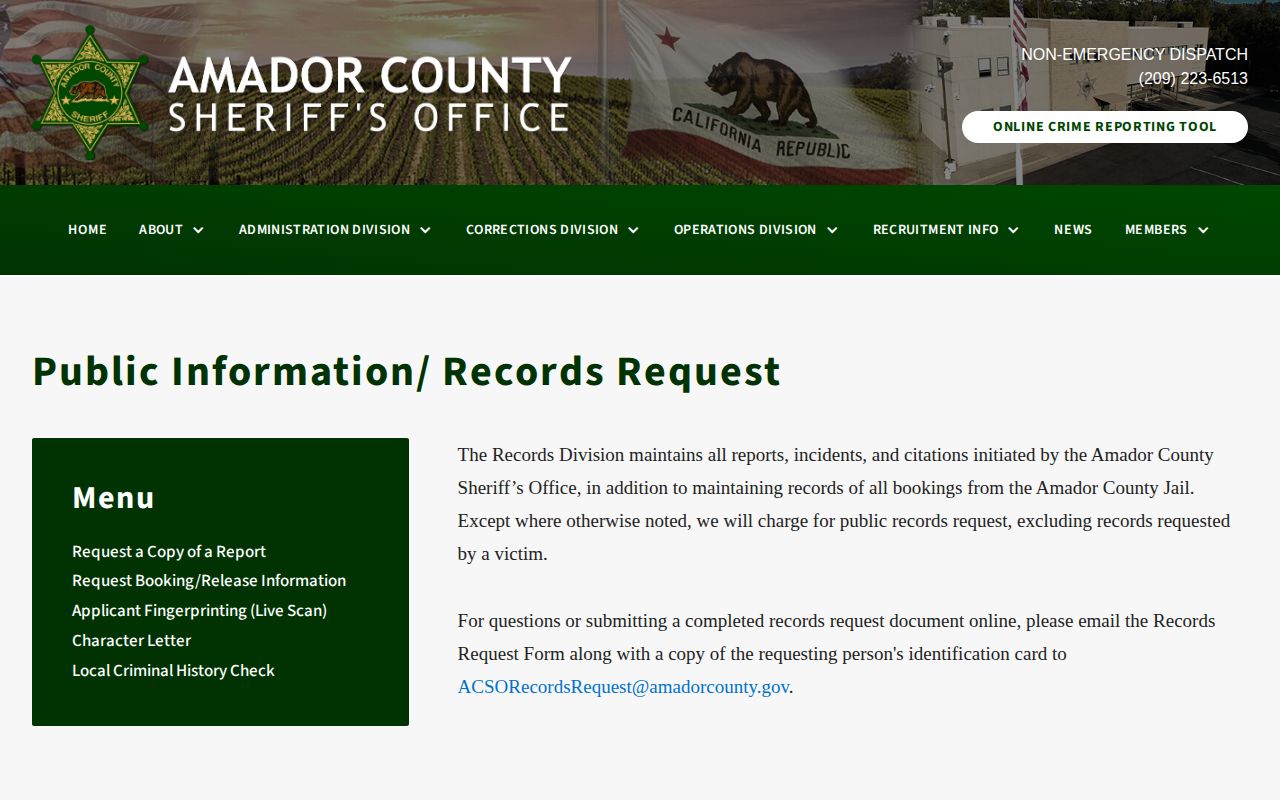
That page is the local confirmation route when a live roster no longer provides a clear answer.
Records requests are also where the public RIMS limitations become manageable. If RIMS showed a booking but not a release list, the booking number and arresting agency can help Records locate the original jail paperwork. If RIMS no longer shows the person, an approximate date range across the last three days can still be useful. If the person was a juvenile, the sheriff records page warns that release of juvenile reports requires a court order or applicable standing order.
After Roster Disappearance
A person leaving the Amador County Jail may be released to the community, released after bail or a court order, placed on local probation or PRCS, transferred to CDCR, transferred to another county, moved to federal custody, or released to immigration custody. The sheriff release record tells you what happened at the jail door; the court docket and receiving agency tell you what happened next.
For CDCR, use CIRIS and CDCR Identification Unit assistance. For parole, use CDCR Division of Adult Parole Operations and BPH hearing results when suitability proceedings matter. For federal custody, use BOP records and federal court dockets. For immigration detention, ICE ODLS is the official locator for people currently in ICE custody or in CBP custody more than 48 hours.
Mule Creek State Prison and Pine Grove Youth Conservation Camp make this distinction especially important in Amador County. A person can be physically located in Amador County because of a CDCR facility without ever being a local Amador County Jail release. CDCR release and parole questions belong with CDCR/CIRIS, CDCR records, BPH, and DAPO. A county jail detainee released to probation or PRCS belongs with the sheriff release document, court docket, and Amador County Probation.
For notification rather than proof, California VINE can be checked during the three-day window. VINE is most useful when registration occurs before release; after release, the person may no longer be available in the active feed. If VINE does not show a result, continue with the sheriff, court, CDCR, BOP, or ICE source that matches the custody path.
Keep notes on the source and time of each check. A live custody screen, a VINE status, and a court docket can update on different schedules, so the most reliable answer is the one confirmed by the agency record owner.
A three-day check should also account for name and data-entry issues. Try the legal last name, known spelling variants, and the booking or court case number when available. If the person was booked by a municipal agency or CHP but housed at Amador County Jail, the arresting agency field may not match the office that owns the release document. The jail release still routes through sheriff Records when the person was booked into the county facility.