
Parole, Probation, and PRCS
Amador readers often use "parole" and "probation" interchangeably, but the record owner changes with the sentence and custody path.
| Supervision type | Who handles it | Best verification path |
|---|---|---|
| County probation | Amador County Probation | Amador Superior Court orders, then Amador Probation contact. |
| PRCS or mandatory supervision | Local probation under California realignment rules | Court docket, probation office, and sheriff records for any jail sanctions. |
| CDCR parole | CDCR Division of Adult Parole Operations | CDCR/CIRIS, BPH results where relevant, then DAPO regional/parole unit contacts. |
| Federal supervised release | Federal court and federal supervision system | BOP status and federal court records, not Amador County Probation unless a separate county case exists. |
Definition: probation is usually part of a local court sentence; parole is commonly tied to release from state prison; PRCS is a local realignment supervision category after certain prison releases. The court order and custody system decide the label.
Verify Amador Supervision Status
There is no single public lookup that proves every supervision status for a released Amador person. Use the custody path.
- Identify whether the release was from Amador County Jail, Mule Creek State Prison, Pine Grove Youth Conservation Camp, another CDCR facility, federal custody, or immigration custody.
- For a local jail release, request the sheriff booking/release document from Amador Sheriff Records if the release path is unclear.
- Search Amador Superior Court's public portal for the disposition, sentencing order, probation order, minute order, dismissal, or commitment order.
- For county probation, PRCS, or mandatory supervision, contact Amador County Probation using the published office information.
- For state parole, search CDCR CIRIS, then use CDCR DAPO regional/parole unit contacts for supervision routing.
- For parole-suitability cases, check BPH schedules and results to understand whether a grant, denial, postponement, waiver, or other action occurred.
- Use California VINE for custody-change alerts, but do not treat a missing VINE result as proof supervision ended.
The manifest includes a capture from CDCR DAPO regional and headquarters contacts.
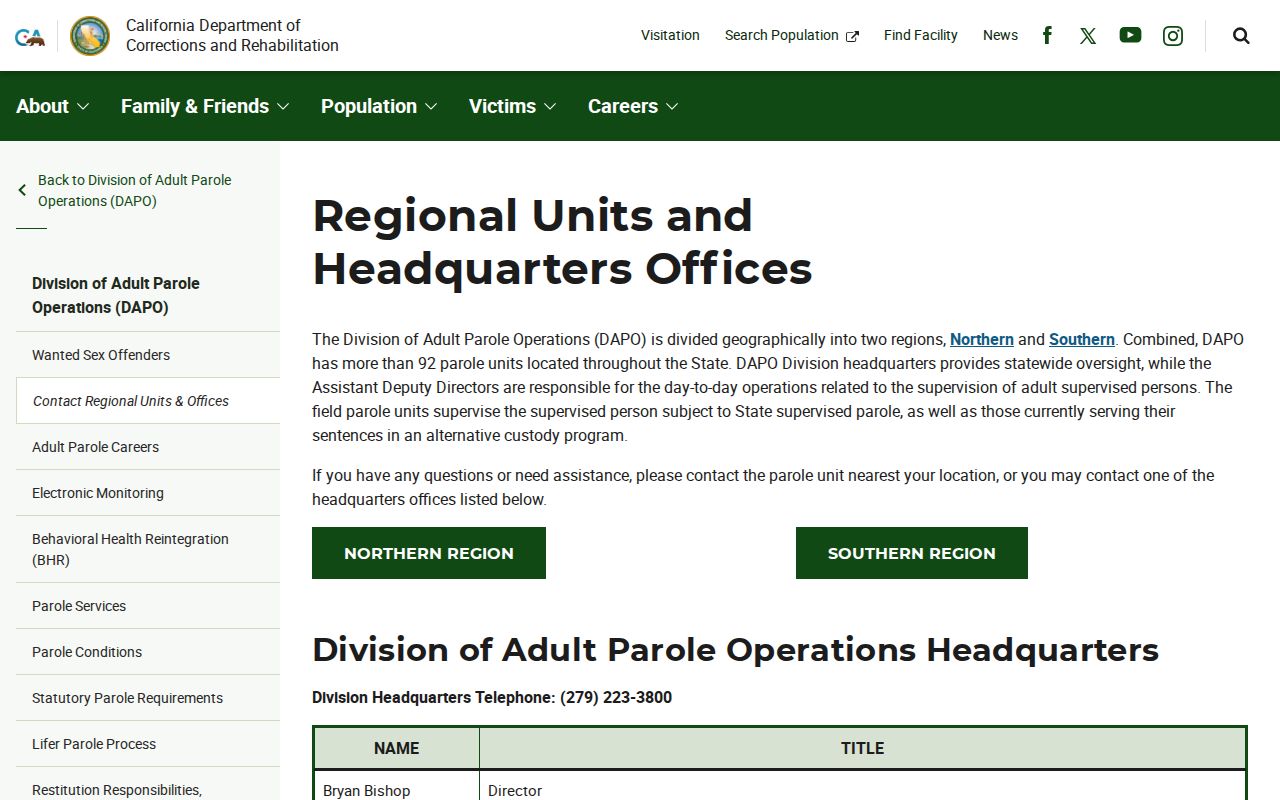
DAPO is the state parole contact path; it does not replace the local Amador Probation office for county probation or PRCS questions.
Amador County Probation Office
Amador County Probation is the local office for county probation and many realignment supervision questions. The department page lists 675 New York Ranch Road, Jackson, CA 95642, phone (209) 223-6387, fax (209) 223-6403, email amadorprobation@amadorcounty.gov, and business hours Monday through Friday, 8:00 a.m. to 5:00 p.m.
Local supervision contact
Amador County Probation Department
675 New York Ranch Road
Jackson, CA 95642
Phone: (209) 223-6387
Fax: (209) 223-6403
Email: amadorprobation@amadorcounty.gov
Hours: Monday-Friday, 8:00 a.m.-5:00 p.m.
Amador Probation is not the state parole board and does not supervise every person released from CDCR. If the person left Mule Creek State Prison to state parole, use CDCR DAPO. If the person left Amador County Jail to local probation or PRCS, Amador Probation and the court docket are the likely local sources.
The court file is the bridge between jail release and local supervision. Amador Superior Court's online case information can include docket entries, charges and dispositions, minute orders, and events for cases within its public access limits. If a release was tied to a probation order, sentence modification, dismissal, or commitment, the court record should explain the legal posture better than a jail roster can.
PRCS and Local Jail Sanctions
Amador's local realignment layer is important. The research cites BSCC-hosted Amador CCP planning materials that discuss PRCS supervision by probation and note that AB109 allows a probation officer to incarcerate a PRCS person for violations for up to ten days without a revocation process. For release research, that means a later Amador County Jail booking may reflect a supervision sanction or violation, not necessarily a new standalone sentence.
To understand a PRCS-related release, compare the sheriff booking/release document with Amador Superior Court records and Probation Department information. The RIMS portal may show booking status, charges, and bail clues, but it does not explain the full supervision context.
This is also why a new jail booking after release should be read carefully. A supervision violation, flash incarceration, court remand, new arrest, or hold can all produce custody records that look similar in a live roster. The release record tells you when local custody ended; the court and probation records explain whether supervision continued, changed, or was violated.
BPH Decisions and DAPO
The California Board of Parole Hearings is within CDCR and conducts parole-suitability proceedings and nonviolent offender parole reviews. It is distinct from Amador County Probation and from DAPO. BPH decides suitability; DAPO supervises many adults after release to parole.
BPH hearing schedules identify date, time, location, and whether the hearing is in person or by video conference. The research notes that the schedule page is updated weekly on Thursday morning. BPH results are posted by week and month and can show outcomes such as grant, denial, postponement, waiver, stipulation, or other action. A proposed grant generally becomes final within 120 days unless review changes the result.
Amador has a specific CDCR relevance because Mule Creek State Prison is in Ione. A person housed there may have a BPH event even if the commitment county is somewhere else. Conversely, a person released from the Amador County Jail on bail, dismissal, sentence credit, or probation usually has no BPH record unless there is also a state-prison case.
DAPO has more than 92 parole units statewide, and the research identified Northern Region directory resources plus service-area clues for Amador through Stockton and Sacramento contacts. Because the non-CDCR service-area listing is not the primary official source, use it only as a clue. Official parole confirmation should come from CDCR DAPO or the appropriate parole unit, paired with CIRIS or CDCR records where available.
No Verified Local Warrant List
Research checked the local absconder/warrant angle. Amador Citizen RIMS has warrants disabled in the public configuration reviewed, and no county-published current warrant or absconder list specific to released Amador jail inmates was verified. This page should not imply that a local online warrant list exists.
For state parole wanted-offender information, use CDCR DAPO resources. For local court or probation issues, use the court docket, probation office, and sheriff records. For urgent safety or custody questions, contact the appropriate public agency directly rather than relying on a missing web listing.
VINE can provide custody-change alerts, but it should not be treated as an absconder or warrant database. A VINE alert may show release, transfer, or custody change when the person is still covered by a participating feed. It will not prove that probation ended, that parole was discharged, or that a warrant exists.
How Supervision Ends
Supervision can end by court order, probation expiration, PRCS or mandatory supervision completion, parole discharge, federal supervised release completion, or another agency action. The proof source depends on the supervision type. County probation completion is documented through court and probation records. CDCR parole discharge belongs with CDCR/DAPO records. Federal supervised release completion belongs with federal court and supervision records.
A released person may also leave one custody system and enter another. "Released from Amador County Jail" may mean release to the community, bail release while the case continues, probation or PRCS, transfer to CDCR, transfer to another county, federal custody, or immigration custody. Use the home page search path when the first question is still "where did this person go after release?"
For county probation or PRCS completion, ask for the court order, docket entry, or Probation Department confirmation that matches the case. For CDCR parole discharge, use DAPO or CDCR records. For a person discharged from state prison with no active parole, the parole office may not have current supervision information, so the CDCR record and sentencing court become more important.
Amador Routing Examples
If RIMS shows a recent Amador County Jail booking and the court docket later shows probation, route the question to Amador County Probation after confirming the release through Sheriff Records. If the court docket shows a CDCR commitment, route the question to CIRIS, CDCR records, and possibly BPH/DAPO. If BOP shows a federal release date, use the federal docket and federal supervision records rather than local probation unless there is a separate Amador case.
If an Amador jail release document says transfer or release to another agency, follow that agency. "Released from this jail" only describes the local custody event. It does not prove freedom from all custody, supervision, court conditions, or future hearings. The most reliable supervision answer comes from matching the release document, court disposition, and supervising agency.
When the records conflict, rely on the newest official source and ask the record owner to reconcile the discrepancy. Live roster data, court dockets, and supervision records can update at different times.