
Booking Photos Are Limited
A booking photo is part of the custody event, but Amador County does not provide a public online mugshot gallery in the sources reviewed. Government Code section 7923.610 supports public access to specified arrest information, including time and manner of release, unless a statutory safety or investigation exception applies. It does not mean every photograph is freely posted online or released in every case.
California also distinguishes public arrest information from restricted criminal-history records. Penal Code section 11105 treats photographs as part of state summary criminal history information, and access to full criminal history is limited. Juvenile, sealed, dismissed-with-relief, confidential, or otherwise restricted records require careful handling through the record owner and court orders.
Amador-specific photo finding: the public RIMS configuration reviewed for this build disables inmate photos and arrest photos. Use RIMS for booking clues, not for a mugshot feed.
That finding changes the page's workflow. In some counties, a recent-release roster also displays a booking photo. Amador's researched portal does not support that claim. The correct public-facing approach is to gather identifiers from RIMS, confirm the release through Sheriff Records and the court, and request any releasable photo through the official records process.
Where a Photo Might Exist
Different systems may hold different images. They do not all publish them, and a release from custody does not automatically make a photo available.
| Channel | Has public photo? | How to use it |
|---|---|---|
| Amador Sheriff Citizen RIMS | No public photo in the reviewed configuration | Use for booking ID, status, charges, bail, and arresting-agency clues. |
| Amador Sheriff Records | Request-dependent | Ask for the booking/release record and any releasable booking photo. |
| CDCR/CIRIS and CDCR records | Not a public mugshot gallery | Use for state custody status; photo access depends on CDCR policy and law. |
| California VINE | Not the official photo source | Use for status and alerts, then confirm with the record owner. |
| News or agency posts | Incidental and time-limited | May identify an arrest, but release confirmation still comes from records and court sources. |
RIMS and the Sheriff App
The Amador Sheriff Citizen RIMS portal is useful for current custody and recent booking context. The public configuration noted in the research includes fields such as booking ID, booking date/time, original arrest date/time, arresting agency, arrest location, released boolean, status, charges, and total bail. It also says inmate photos and arrest photos are disabled.
The Amador County Sheriff's Office OCV mobile app exists, and the research notes a Google Play listing updated May 29, 2026. The app description supports public-safety news, tips, and reporting features, but it does not prove an inmate lookup, release list, or mugshot feed. This page therefore treats the app as a sheriff communication channel, not as a photo source.
For recent release context without photos, use the 24-Hour Releases and 72-Hour Releases pages. Both explain that Amador has no verified rolling release feed and that sheriff Records is the confirmation path.
The same caution applies to social or app-based tips. A sheriff outreach app or public-safety post may mention an incident, but it is not the release document and it may not stay online. If the question is whether the person has been released, use the release record and docket. If the question is whether a booking photo can be obtained or corrected, use the records and legal channels described here.
Request a Booking Photo
The local booking-photo request starts with Amador County Sheriff's Office Records Division. The sheriff records page says Records stores original booking and release documents from the Amador County Sheriff's Detention Facility and accepts completed forms, including by email to ACSORecordsRequest@amadorcounty.gov with identification.
- Identify the person by full legal name and date of birth if known.
- Include the booking number, approximate booking date, arresting agency, and Amador County Jail as the facility if known.
- Ask for the booking/release document, release date and time, manner of release, and any releasable booking photo connected to that booking.
- Ask for redaction rather than full denial if exempt details are mixed with releasable arrest information.
- Use the court portal or Clerk's Office if the photo question depends on a sealed, juvenile, dismissed, or otherwise restricted case.
The manifest includes a capture from Government Code section 7923.610, the California arrest/release public-information statute.
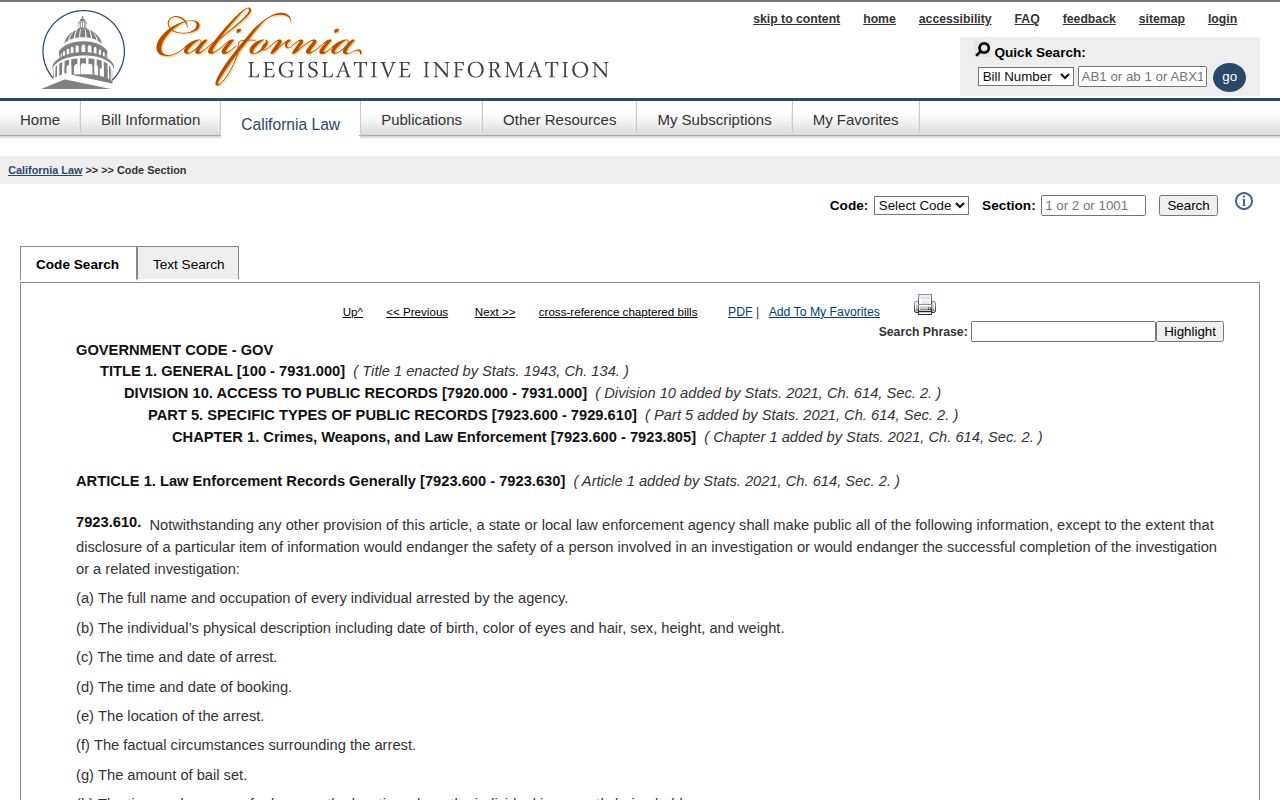
Use the statute as a public-information anchor for arrest and release facts, while recognizing that photo release can still be limited by other law and policy.
If the request is denied or heavily redacted, compare the reason with the case status. A juvenile matter, sealed arrest, sensitive investigation, protected victim or witness information, or court order may limit release. A requester can narrow the request to the booking/release record, time and manner of release, or nonexempt arrest information when the photo itself is not releasable.
CDCR Photos Are Separate
CDCR may maintain state identification photographs for people in its custody, including people housed at Mule Creek State Prison or Pine Grove Youth Conservation Camp. Those photos are not Amador County Jail mugshots and are not controlled by the Amador Sheriff's Records Division unless there was a separate county jail booking.
CIRIS and CDCR records can help identify a state inmate, current location, commitment county, admission date, and BPH information where public rules allow. A state-prison photo request belongs with CDCR's records channels, and release depends on CDCR policy, public-record exemptions, criminal-history restrictions, and confidentiality rules.
Pine Grove Youth Conservation Camp requires additional caution because the research notes a specialized CDCR youth conservation camp context and possible confidentiality limits. The site should not imply that every participant has a public adult jail-style photo or release file. When the custody path involves CDCR, the sending county, or juvenile/court authority, use those official channels rather than the Amador jail photo request route.
Third-Party Sites and News
Commercial mugshot sites and old news posts are not official proof of an Amador release. They may be outdated, may show an arrest without a disposition, and may omit dismissal, sealing, sentence completion, transfer, or later correction. This site should not send users to predatory photo sites as a primary source.
California Civil Code section 1798.91.1 makes it unlawful for a person engaged in publishing or disseminating a booking photograph through print or electronic media to solicit, require, or accept payment or other consideration from the subject to remove, correct, modify, or refrain from publishing the booking photograph. If a site demands payment for removal or correction, the statute, counsel, and consumer complaint routes are more relevant than another search.
News sources have a narrower role. A local or regional article may document an arrest or agency announcement, but it may not update after charges change, a person is released, or a case is sealed. Treat news images as historical reporting, then verify the current custody and release facts through the sheriff, court, CDCR, BOP, ICE, or VINE as appropriate.
Removal, Sealing, and Social Posts
California law also limits law-enforcement social-media publication of booking photos. The research cites DOJ Legal Alert OAG-2024-05 regarding Penal Code section 13665, which discusses removal of booking photos shared by California law-enforcement agencies on social media within 14 days unless specified circumstances continue. That rule does not create a public online photo feed, but it matters when an agency once posted a photo.
California Courts explains that record-cleaning rules are case-specific and that arrests with no conviction may be sealable under Penal Code section 851.91. A sealed or restricted case may change access to records and photos. For Amador County, check the Amador Superior Court docket and records process, then ask the record owner about correction, restriction, or removal.
Record relief does not necessarily erase every trace from every system at the same time. Court records, sheriff booking records, CDCR files, and third-party copies can follow different rules and timelines. The practical order is to obtain the court order or docket entry, send it to the record owner that controls the photo or release record, and keep copies of any response or correction.
Use Photos Only to Identify Records
Booking photos can be misleading without the matching record. A same-name person, old arrest, dismissed case, transfer, or later release can make an image look more current than it is. In Amador County, where the public RIMS route does not display photos, the safer method is to match the booking number, arrest date, facility, court case, and release record before drawing conclusions from any image found elsewhere.
For a released local jail detainee, the strongest evidence remains the sheriff booking/release document and Amador Superior Court docket. For a released state prisoner, use CDCR records, BPH history where relevant, and DAPO/parole information. A photo by itself does not establish release date, supervision status, case disposition, or whether another custody system became involved.
If the goal is correction, start with the official record that is wrong or incomplete. A corrected court disposition or sheriff response is more useful than an old image saved from an unofficial page, because it identifies the agency responsible for the underlying record.
For Amador County Jail, that usually means Sheriff Records and Amador Superior Court. For Mule Creek or Pine Grove, it usually means CDCR records and the originating court or county. Keeping those paths separate prevents a county jail photo request from being used for a state-prison record that the sheriff does not control.